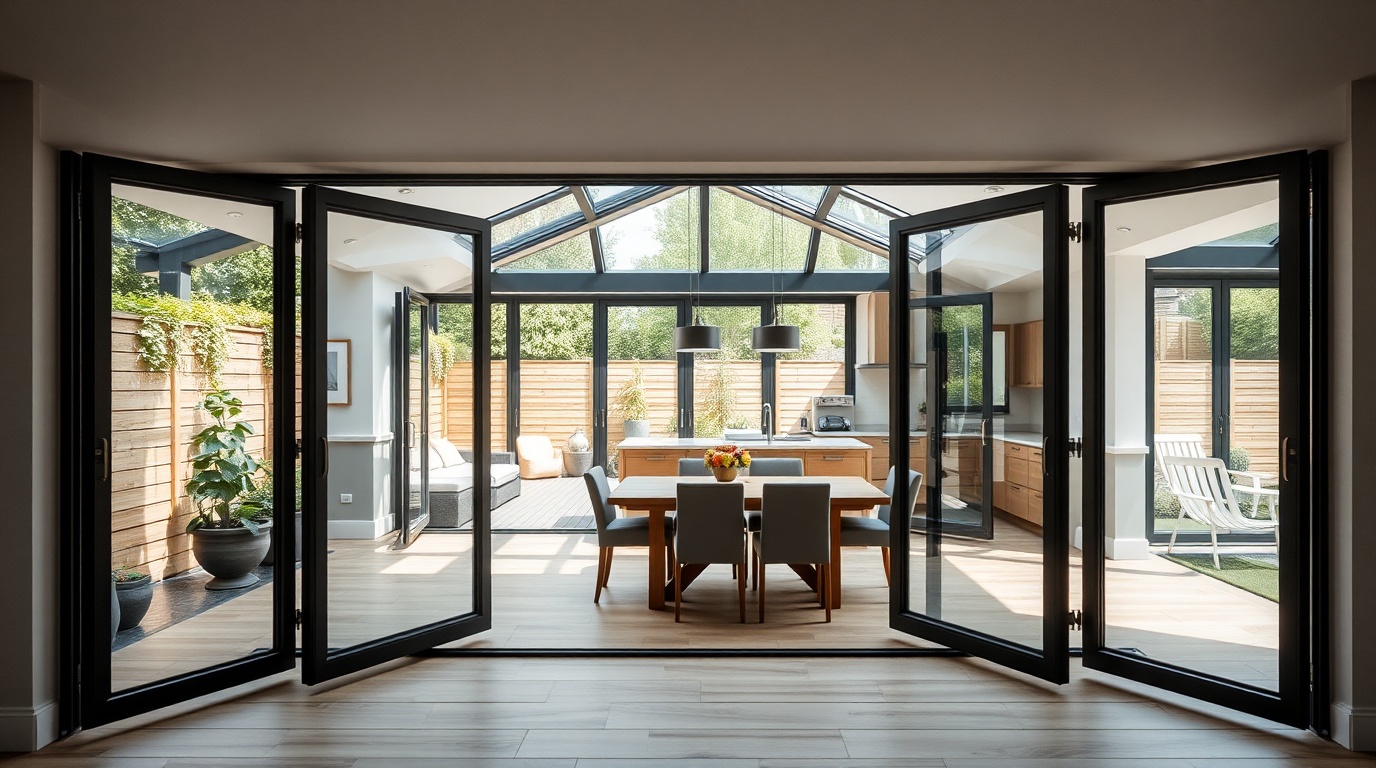
The short answer
A 2-door bifold suits openings up to about 1.8 metres and folds in two panels, while a 3-door bifold covers roughly 1.8 to 2.7 metres and adds a third panel plus the option of a lead or traffic door for everyday use. The two-panel version is simpler and lower in cost, but with an even number of panels it usually folds to one side and lacks a single hinged access door. The three-panel version, with an odd number, commonly includes a traffic door so you can pass through without folding the whole set. For most patio-sized openings the three-pane is the popular choice, while the two-pane suits narrower gaps and tighter budgets where a separate walk-through door is not needed.
The jump from two to three panels is about more than width; it usually adds a traffic door that changes how you use the doors day to day.
Quick reference
- 2-pane openingUp to ~1.8m
- 3-pane opening1.8–2.7m
- Traffic doorUsual on 3-pane
- Price gap3-pane costs more
2-pane and 3-pane compared
The table sets out the practical differences between two and three-panel bifolds, with indicative UK 2026 fitted price ranges into an existing opening. Both are common replacements for patio and French doors, and the right one depends mainly on the width of your opening and how you want to use the doors each day.
A two-pane set is the simplest bifold layout, with two leaves that fold together to one side. A three-pane set adds a third leaf and, with its odd number of panels, lends itself to a traffic door arrangement. The price difference between them is modest compared with the larger effect of overall width, glazing specification and threshold type.
| Feature | 2-pane | 3-pane |
|---|---|---|
| Typical width | Up to 1.8m | 1.8–2.7m |
| Fold pattern | Both to one side | Often 2+1 with traffic door |
| Everyday access | Fold both panels | Use traffic door |
| Frames in view | One central join | Two joins |
| Fitted price | £2,200–£4,000 | £2,500–£5,000 |
Indicative UK figures; configuration and glazing affect the range.
How they open differently
The number of panels affects how the doors fold and how you use them daily. With a two-pane set the only way to open up is to fold both leaves back, which is fine for letting in air and light but less convenient for a quick step into the garden. A three-pane set with a traffic door lets you use a single hinged leaf for everyday access, keeping the rest of the run closed and sealed.
- 2-pane: the two panels fold together to one side, with no separate hinged door, so you open both panels even for quick access.
- 3-pane: a common split is two panels folding one way plus a single traffic door, letting you step through without unfolding the set.
- Stacking space: the three-pane stacks slightly more panels to the side when fully open, so allow clear space at the jamb.
- View when closed: the three-pane has one more frame dividing the glass, a small trade-off for the extra width and access.
Which to choose
For a narrow opening around 1.5 to 1.8 metres, a two-pane bifold is the natural fit, simpler and lower in cost. For a typical patio or rear opening of 2 to 2.7 metres, a three-pane gives a better balance of panel width and usually includes a traffic door, which most households find more convenient for everyday in-and-out access without folding the whole run.
The odd-panel three-pane configuration is one of the most popular bifold layouts in UK homes for exactly this reason. If a traffic door matters to you, an odd number of panels makes it easier to achieve. If your opening genuinely is narrow and a walk-through door is not a priority, the two-pane keeps the cost down and still gives the wide, folding-back opening that defines a bifold.
Cost and practical considerations
Beyond width and access, a few practical points separate the two. A three-pane set has an extra leaf, hinge set and pane of glass, so it costs somewhat more and weighs more overall, but the difference is smaller than the jump you would see by widening the opening or upgrading the glazing. Both layouts use the same quality of running gear, seals and threshold options, so the choice does not affect weather performance or durability.
Think about where the folded panels will rest, since even a two-pane set needs clear space at one jamb when open. Consider the threshold too: a low or flush threshold gives level access from inside to patio but needs careful weather detailing on either configuration. For most homeowners the decision is led by opening width first, then by whether a traffic door is wanted, with price a secondary factor that a survey will pin down for your exact opening.
Frequently asked questions
Does a 2-pane bifold have a traffic door?
Usually not. With an even number of panels, both leaves fold together and there is no single hinged access door, so you open both panels even for quick access. A traffic door is more typical on odd-panel sets like a three-pane.
Is a 3-pane bifold much more expensive than a 2-pane?
A three-pane costs somewhat more because it has an extra panel, hinge and more glass, but the gap is modest. The bigger factor is overall width, glazing and threshold specification rather than the panel count alone.
Which is better for a patio?
For most patio openings of 2 to 2.7 metres, a three-pane bifold is popular because it suits the width and usually includes a traffic door. A two-pane suits narrower openings up to about 1.8 metres.
Can a 2-pane bifold fold both ways?
Generally no. With only two leaves they fold together to one side. Splitting the stack to both sides needs more panels, so it is a four or six-pane feature rather than a two-pane one.
How much clear space do the folded panels need?
Allow space at the jamb roughly equal to the panel width for the stacked leaves. A two-pane stacks two leaves to one side; a three-pane stacks more, so plan the furniture and walkway around the open position.
Sources & further reading
- HomeOwners Alliance — bifold doors guide
- Checkatrade — bifold door cost guide
- MyJobQuote — bifold door prices
Figures on this page are typical UK ranges drawn from published sources and depend on your specific opening and material. They are guidance, not a quotation.