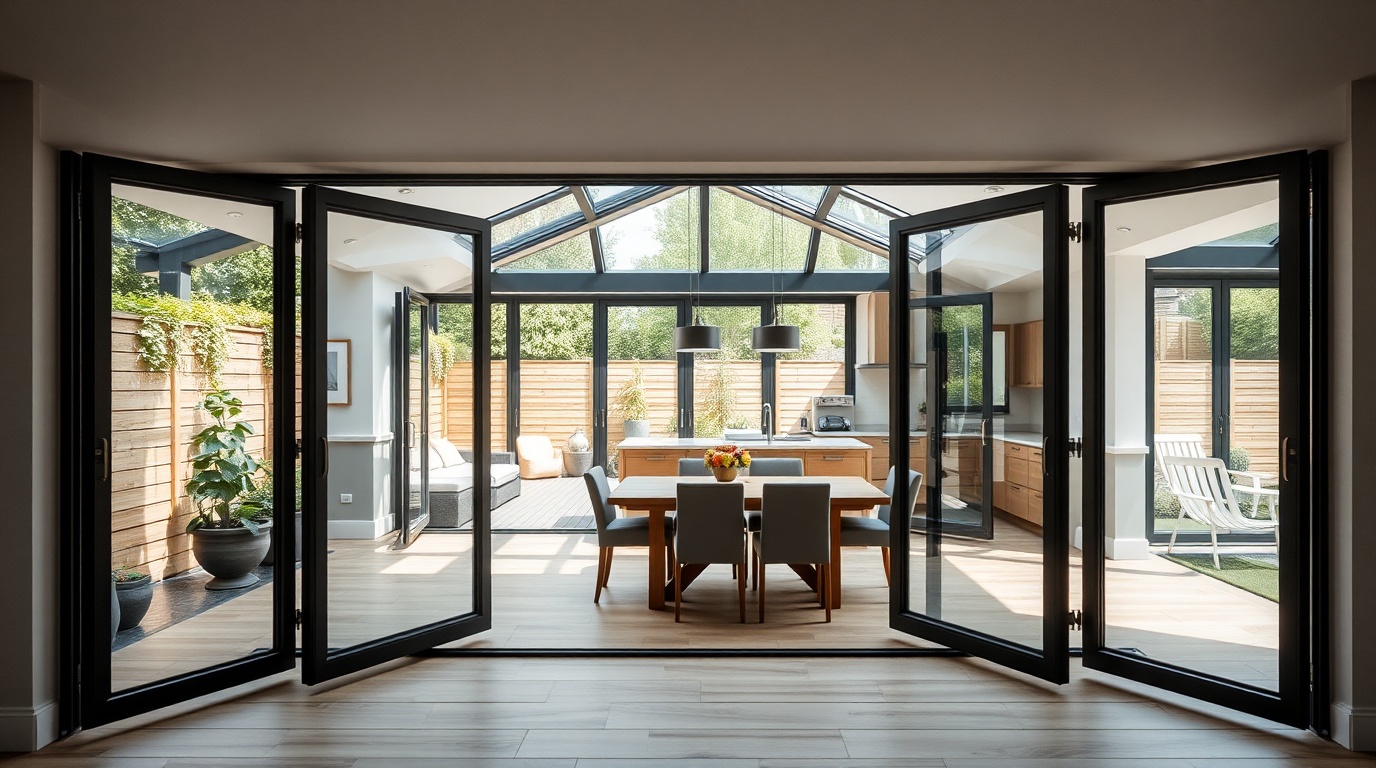
The short answer
A 4-door bifold suits openings of roughly 2.4 to 3.6 metres and an even split lets panels fold to both sides, while a 5-door bifold covers about 3 to 4.5 metres and, being odd-numbered, more easily includes a traffic door. The four-pane often folds two panels each way from the centre, or all four to one side. The five-pane gives a wider span and the option of a single hinged traffic door at one end for everyday access. Choosing between them comes down to your opening width, whether you want panels stacking one side or both, and how important a traffic door is for daily use in the room.
At these wider spans, the choice is shaped by how you want the panels to stack and whether a traffic door fits the layout.
Quick reference
- 4-pane opening2.4–3.6m
- 5-pane opening3.0–4.5m
- 4-pane fold2+2 or 4 one side
- 5-pane foldOften 4+1 traffic door
4-pane and 5-pane compared
The table compares the two configurations with indicative UK 2026 fitted price ranges. Both are common on extension rear walls and wide patio openings, where the bifold opens most of the wall to the garden. The main differences are the overall width each suits, the way the panels stack when folded, and how naturally a traffic door fits.
A four-pane set has an even number of leaves, which allows a symmetrical split with panels folding to both jambs. A five-pane set spans wider while keeping each leaf within sensible width limits, and its odd panel count makes a single hinged traffic door at one end straightforward to include.
| Feature | 4-pane | 5-pane |
|---|---|---|
| Typical width | 2.4–3.6m | 3.0–4.5m |
| Common fold | 2+2 from centre | 4+1 with traffic door |
| Traffic door | Possible but less natural | Easier with odd panel |
| Stack position | Both jambs or one | Usually one jamb |
| Fitted price | £3,500–£6,500 | £4,500–£8,000 |
Indicative UK figures; glazing and threshold choices affect the range.
Fold patterns explained
The number of panels shapes how the doors stack when open, which in turn affects the room layout and where you can place furniture. An even-numbered set can divide the stack between both sides, while an odd-numbered set tends to gather most leaves at one jamb with a traffic door at the other.
- 4-pane, 2+2: two panels fold left and two fold right from the centre, splitting the stack evenly to both jambs and clearing the middle of the opening.
- 4-pane, all one side: all four fold to a single jamb, clearing one side fully but stacking a thicker bundle of leaves.
- 5-pane, 4+1: four panels fold one way with a single traffic door, giving a wide opening plus easy daily access.
- 5-pane, other splits: some systems offer 3+2 or similar arrangements to suit the room layout and where you walk in and out.
The right pattern depends on where you want the folded panels to sit and how the furniture and traffic flow work in the room.
Choosing for your opening
If your opening is around 2.4 to 3.6 metres, a four-pane gives sensible panel widths and the flexibility to fold both ways. For wider openings of 3 to 4.5 metres, a five-pane keeps individual panels within sensible width limits while spanning more of the wall, and its odd panel count makes a traffic door easier to incorporate.
Consider where you will walk in and out most, whether you want a clear stack to one side, and how the panels will sit against the wall when folded. As panel count rises, getting the structural opening and lintel right becomes more important, since the span carries more load and a wider, heavier run puts more demand on the running gear and the beam above. A surveyor will confirm the achievable width and the right split for your space.
Cost, weight and operation
A five-pane set costs more than a four-pane because it has an extra leaf, hinge set and pane of glass, and usually spans a wider overall opening that needs a stronger frame and a larger structural beam. Across both configurations, the biggest cost drivers remain overall width, glazing specification and threshold type rather than the panel count on its own.
Operation is worth thinking about at these widths. More and wider panels mean more weight to fold, so quality running gear matters to keep the doors smooth over the years. A traffic door on the five-pane reduces wear, because daily access uses one hinged leaf rather than folding the whole run each time. Whichever you choose, the opening must be square, level and supported by a correctly sized lintel so the panels fold cleanly and the seals stay weathertight.
A practical way to decide between the two is to start from the opening width and then check the everyday details. If your span sits around 2.4 to 3.6 metres, the four-pane is the natural fit and lets you choose between splitting the stack to both sides or folding all four to one jamb. If the span is wider, towards 3 to 4.5 metres, the five-pane keeps each leaf a sensible width and gives you the traffic door almost for free thanks to the odd panel count. Then picture the room: where the folded panels will rest, whether furniture or a wall return limits one side, and how often you will step in and out without opening the full width. Those everyday factors usually tip the decision more clearly than the headline price, since the cost gap between the two reflects the extra leaf and the wider span rather than a difference in quality. The surveyor can then confirm the achievable width, the split and the beam design so the finished door folds smoothly and suits how the room is used.
Frequently asked questions
Can a 4-pane bifold have a traffic door?
It can, but with an even number of panels a traffic door is less natural. Odd-panel configurations like three or five make a single hinged access door easier to include in the run.
Is a 5-pane bifold much dearer than a 4-pane?
A five-pane costs more because it has an extra panel and more glass, and usually a wider overall span. The exact gap depends on width, glazing and threshold specification rather than panel count alone.
Which folds away more neatly?
Both stack neatly; the difference is where. A 4-pane can split the stack to both sides, while a 5-pane often stacks four panels one side with a traffic door, clearing most of the opening.
Do wider bifolds need a bigger steel beam?
Yes. A wider opening carries more load from the wall above, so it needs a larger, engineer-designed lintel or steel beam. The structural work is a key part of any wide bifold project and is signed off by building control.
How wide can each panel be on these sets?
Individual panels are usually kept up to around 1 metre. A five-pane spreads a wide span across more leaves, keeping each within sensible limits, which helps the doors fold smoothly and reduces sagging over time.
Sources & further reading
- HomeOwners Alliance — bifold doors guide
- Checkatrade — bifold door cost guide
- MyJobQuote — bifold door prices
Figures on this page are typical UK ranges drawn from published sources and depend on your specific opening and material. They are guidance, not a quotation.