The short answer
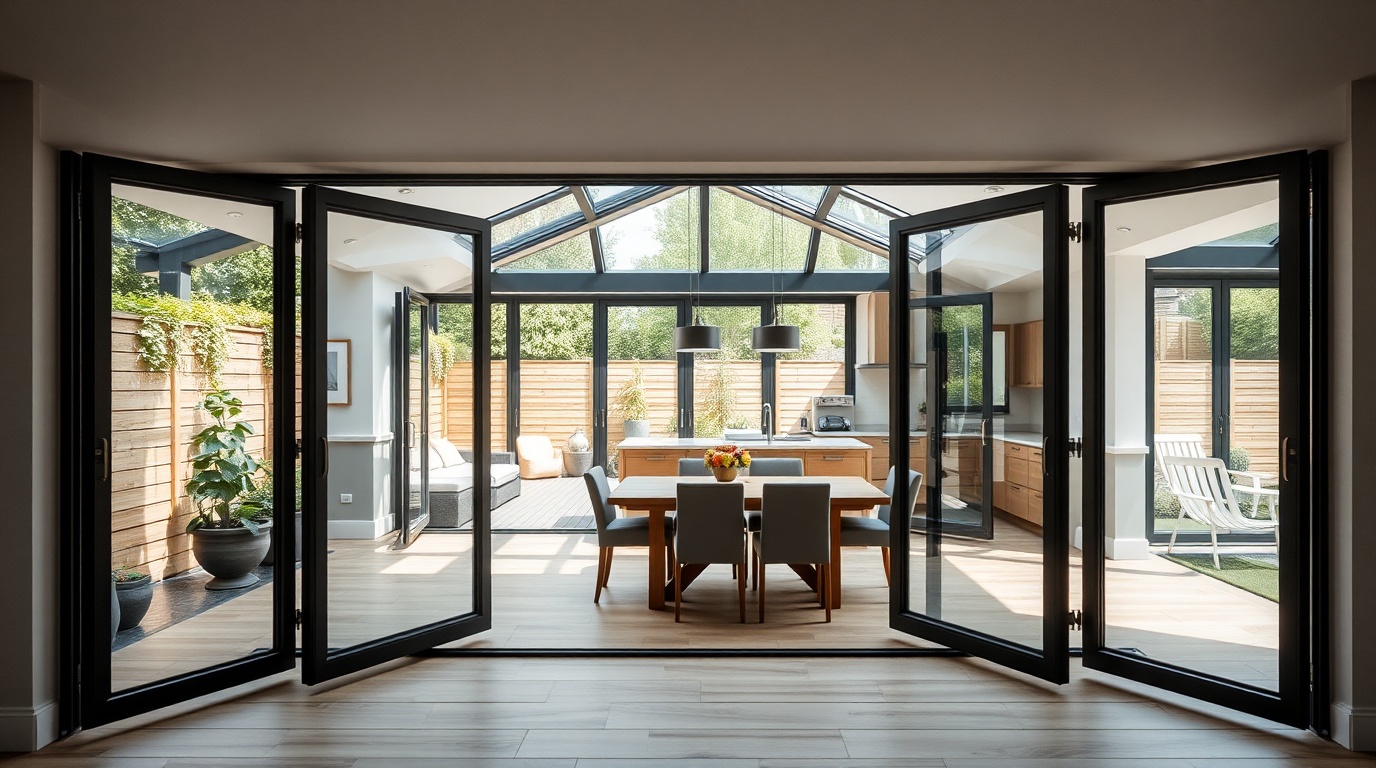
French doors suit narrower openings and tighter budgets; bifolds suit wide openings where you want the whole wall to fold back. A pair of French doors typically spans up to about 1.8m and opens as two hinged leaves, giving a clear, framed view and a traditional look at a lower cost. Bifold doors use multiple panels that concertina to one or both sides, so a three-, four- or five-panel set can open up an opening of 2.4m to 6m or more almost completely, dissolving the boundary between inside and garden. Bifolds cost more per metre and have more frame visible when closed, but they open wider. For openings under roughly 2m, French doors are usually the simpler, cheaper choice; for wider spans where you want maximum opening, bifolds win.
Bifold and French doors solve the same job — connecting a room to a garden or patio — but in very different ways. The sections below compare them on the points that actually decide the choice: opening size, cost, view, threshold and everyday use.
Bifold vs French at a glance
- French doorsTwo hinged leaves, up to ~1.8m
- Bifold doorsFolding panels, 2.4m to 6m+
- French costUsually lower
- Bifold costHigher per metre
- SuitsFrench: narrow; bifold: wide
How they compare
The clearest way to decide is to line up the two doors against the factors that matter day to day: how wide the opening is, how much of it you can open, the cost, and how the threshold and frame behave. French doors are a pair of hinged doors, so they suit a standard-width opening and open like a stable door onto the garden. Bifolds are a run of panels on a top or bottom track that fold flat against the reveal, so a wider opening can be almost fully opened. The table sets out the practical differences.
| Factor | French doors | Bifold doors |
|---|---|---|
| Typical opening width | Up to ~1.8m (pair) | 2.4m to 6m+ |
| How it opens | Two hinged leaves | Panels concertina aside |
| Clear opening when fully open | About 75-90% of width | Up to ~90% of width |
| Frame visible when closed | Less | More (panel stiles) |
| Typical UK supply-and-fit cost | £1,200-£3,500 | £3,000-£10,000+ |
| Well suited to | Narrower openings | Wide openings |
Indicative UK figures for guidance; actual costs depend on size, material and glazing.
Opening width, view and frame
The biggest difference is how much of the wall you can open. French doors are a fixed pair, so beyond about 1.8m you would need to add fixed side panels, which keeps the opening the same. Bifold doors add panels as the opening grows, so a four- or five-panel set can fold almost the entire wall away, which is why they are popular for kitchen-diner extensions opening onto a patio.
When closed, the trade-off reverses. French doors have less frame — typically a slimmer central meeting point and outer frame — so the glazed area and the view are cleaner. Bifolds have a vertical stile on each panel, so a wide run shows several uprights across the glass. Slim-frame aluminium bifolds reduce this, but a closed bifold will always show more frame than a pair of French doors. If the doors will spend most of the year closed and the view matters more than the opening, that is a point in French doors' favour; sliding doors are a third option worth weighing where an uninterrupted view is the priority.
Cost, threshold and everyday use
Cost is usually the deciding practical factor. French doors are simpler to make and fit, so a supply-and-fit pair commonly falls in the £1,200-£3,500 range depending on material and glazing. Bifolds have more panels, hinges, rollers and a more complex track, so even a modest three-panel set typically starts around £3,000 and a large aluminium run can run well past £8,000-£10,000. If budget is tight and the opening is narrow, French doors give most of the benefit for far less.
Threshold and use also differ. Both can be specified with a low or flush threshold for level access, though a fully flush detail needs careful drainage design. French doors swing in or out, so you need clearance for the leaves; bifolds slide along a track and stack to the side, so they suit spaces where a swinging door would foul furniture. For everyday in-and-out use, many bifold sets include a 'traffic door' — a single panel that opens on its own without folding the whole set back — which makes them practical day to day, not just for summer entertaining.
Frequently asked questions
Are bifold doors more expensive than French doors?
Generally yes. French doors are simpler and usually cost £1,200-£3,500 supply-and-fit, while bifolds start around £3,000 and large aluminium runs can exceed £8,000-£10,000. The gap reflects the extra panels, hinges and track in a bifold.
Which is better for a narrow opening?
For openings under roughly 2m, French doors are usually the better choice — they cost less, show less frame and give a clean view. Bifolds only start to make sense once the opening is wide enough to benefit from folding several panels aside.
Do French doors or bifolds give a better view when closed?
French doors usually give a cleaner view when closed because they have less frame across the glass. A bifold shows a vertical stile on each panel, so a wide run has several uprights; slim-frame aluminium bifolds reduce this but never quite match a pair of French doors.
Sources & further reading
Figures on this page are typical UK ranges drawn from published sources and depend on your specific opening and material. They are guidance, not a quotation.