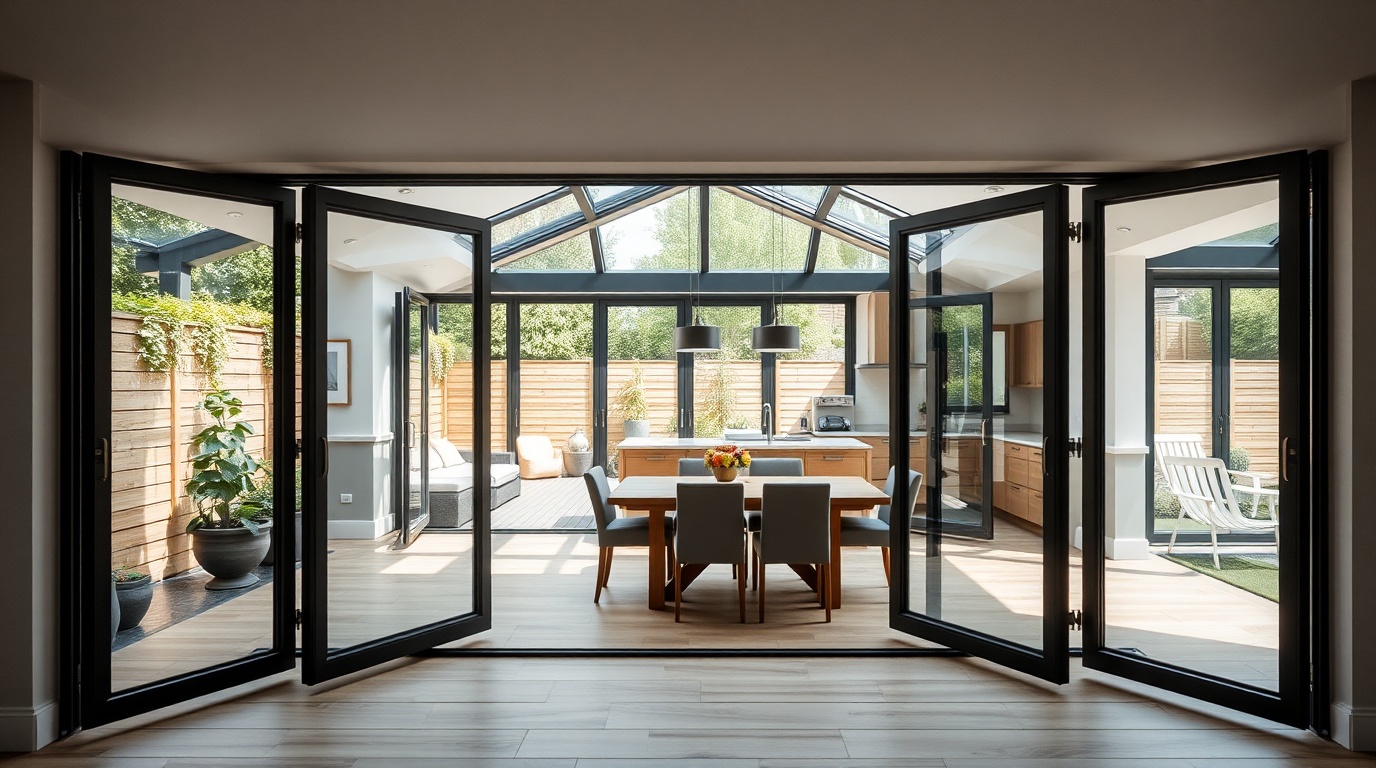
The short answer
A standard bifold folds its panels in hinged pairs that concertina to the side; a slide-and-turn system lets each panel slide independently along a track and then turn to stack flat, like books on a shelf. Both open a wide opening, but they behave differently. Bifolds fold in linked pairs and need the panels hinged together, so they open as a set. Slide-and-turn panels are individually moveable, so you can slide one panel aside for everyday access, or move them all and turn them to stack neatly at one end. Slide-and-turn often suits very wide openings and gives more flexibility in where the stack sits, while classic bifolds are more common, usually cheaper and widely supported by UK installers.
Slide-and-turn (sometimes called slide-and-fold or slide-and-stack) is a close cousin of the bifold, and the names get mixed up. The sections below explain how the two systems actually differ and where each works well.
Bifold vs slide-and-turn
- Bifold panelsHinged in linked pairs
- Slide-and-turn panelsMove independently, then turn
- StackingBifold folds aside; slide-and-turn stacks like books
- FlexibilitySlide-and-turn higher
- AvailabilityBifold more common in UK
How the two systems move
The core difference is how the panels travel. A bifold hinges its panels together in pairs, so when you push the lead panel the others follow and concertina to one or both sides as a connected run. A slide-and-turn system hangs each panel from a top track on its own carriage, so panels slide individually and then pivot (turn) to sit flat against a wall or each other at the end of the run, rather like sliding books along a shelf and turning them to stack.
In practice that means a bifold opens as a set, while slide-and-turn gives you more control over individual panels — useful for nudging just one panel aside or arranging the stack to suit the space. The table summarises the differences.
| Factor | Bifold | Slide-and-turn |
|---|---|---|
| Panel movement | Hinged pairs concertina | Each panel slides then turns |
| Everyday access | Traffic-door panel | Slide one panel aside |
| Stack arrangement | Folds to reveal | Stacks flat at one or both ends |
| Suits very wide openings | Yes | Yes (often used for large spans) |
| UK availability | Very common | Less common, specialist |
| Typical cost | £3,000-£10,000+ | Similar to higher |
Indicative UK guidance; cost and availability vary by supplier and span.
Flexibility, stacking and view
Slide-and-turn systems are valued for flexibility on very wide or unusually shaped openings. Because each panel moves independently, you can stack them at one end, split them between two ends, or even take some panels round a corner with the right track. That makes them popular for large openings, conservatories and commercial spaces where a long run of glass needs to disappear neatly. The trade-off is that they are more specialist, so fewer UK installers offer them and the cost can be higher for a given quality.
A standard bifold is more constrained — panels fold in linked pairs to a fixed side — but that simplicity is also its strength: the system is mature, widely supported, and usually more affordable, with plenty of installers and replacement parts. On the view, both show frame on every panel when closed, so neither matches a slider for an uninterrupted view; if a clean closed view is the priority, a sliding door is the better comparison than either folding system.
Frequently asked questions
Is slide-and-turn the same as a bifold?
They are close relatives but not identical. A bifold folds its panels in hinged pairs, while a slide-and-turn system lets each panel slide independently and then turn to stack flat. Slide-and-turn offers more flexibility on where panels stack; bifolds are simpler and more common.
Which is better for a very wide opening?
Slide-and-turn is often chosen for very wide or awkward openings because each panel moves independently and can stack neatly at one or both ends, or round a corner. Standard bifolds also handle wide openings well but fold to a fixed side in linked pairs.
Are slide-and-turn doors more expensive than bifolds?
They can be, because they are more specialist and fewer UK installers offer them. Costs overlap with bifolds but tend toward the higher end for comparable quality. Standard bifolds are usually easier to source and service.
Sources & further reading
Figures on this page are typical UK ranges drawn from published sources and depend on your specific opening and material. They are guidance, not a quotation.