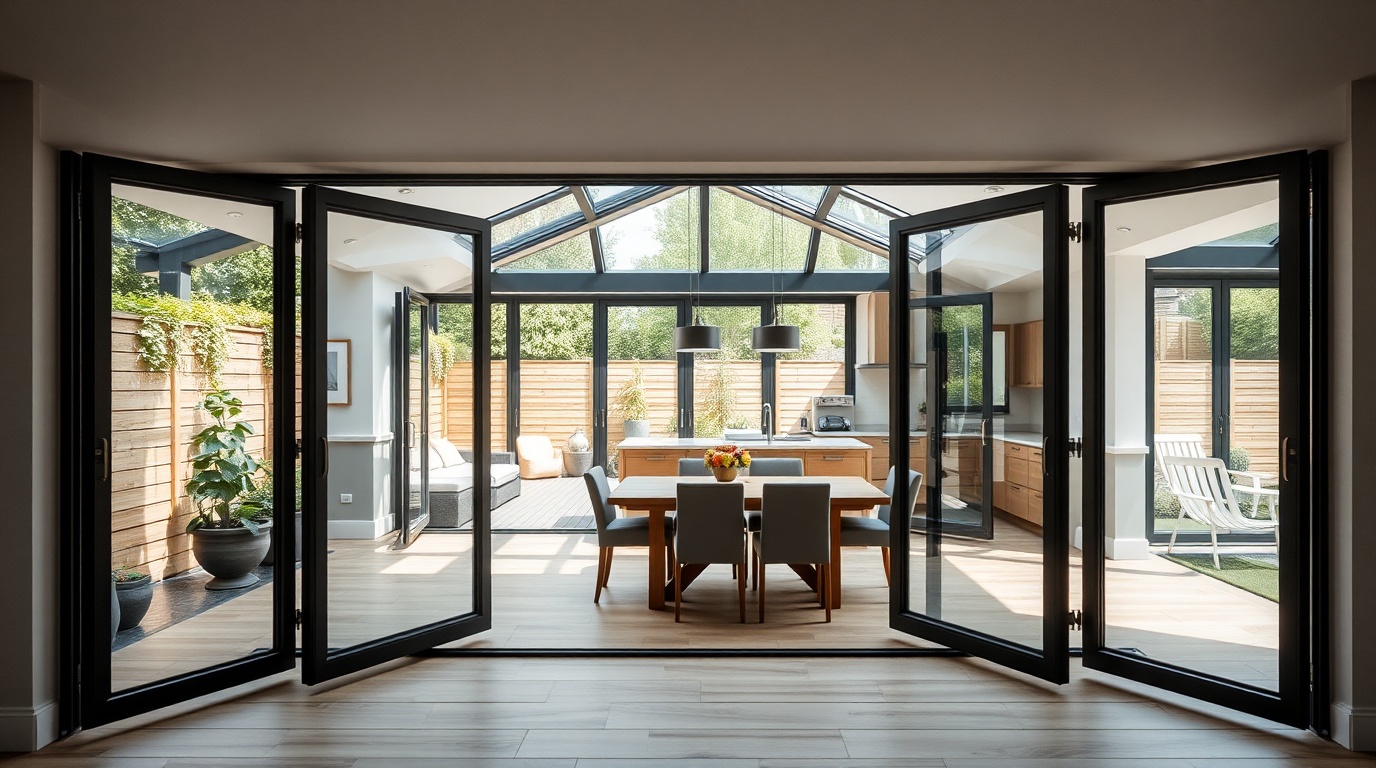
The short answer
Yes. Bifold doors run on a bottom track and sit on a threshold — the panels are carried by rollers that travel along a track at floor level, and the threshold is the weatherproofing detail where the doors meet the floor. The decision you have to make is the type of threshold. A standard (weathered) threshold stands slightly proud of the floor and gives the best weather protection, while a low or flush threshold sits almost level with the finished floor for a near-seamless inside-to-outside transition and step-free access. Flush thresholds suit accessibility needs and align with Part M access aims, but the detail must be designed carefully to stay weathertight. The track and threshold are integral to how bifolds work and cannot be omitted.
Every bifold door needs a bottom track and a threshold, but the type you choose shapes both weatherproofing and accessibility. Here is how the options compare and what to weigh.
Threshold options
- Track needed?Yes — carries the rollers
- Standard thresholdBest weather protection
- Low / flush thresholdStep-free, near-level
- AccessibilityFlush aligns with Part M aims
- Trade-offFlatter = more drainage care
Why a track and threshold are essential
A bifold door is a set of panels that slide and fold, and the mechanism that makes this possible is the track. Most bifold systems carry the weight of the panels on rollers running in the bottom track (some are top-hung, but a floor track and threshold detail are still present), guided by a corresponding channel at the head. The threshold is the part of the frame at floor level — it provides the running surface, the weatherproofing where the doors meet the floor, and the drainage that channels rainwater away from the opening.
Because of this, you cannot have bifold doors without a track and threshold; they are intrinsic to how the doors operate and stay weathertight. What you can choose is the profile of the threshold — how high it stands and how it integrates with your floor. This single choice affects the look of the transition between inside and out, how easy it is to step or wheel across, and how the doors handle driving rain. It is worth deciding early, because the threshold type influences the floor build-up and the way the opening is prepared, so it is best agreed at the survey stage rather than changed later.
Standard versus low and flush thresholds
Threshold options sit on a spectrum from most weatherproof to most accessible:
- Standard (weathered) threshold: stands a little proud of the internal floor with an upstand that helps keep wind-driven rain out. It offers the best weather protection and is the most robust choice for exposed elevations, at the cost of a small step.
- Low threshold: a reduced-height profile that lessens the step while retaining reasonable weather performance — a middle-ground option.
- Flush (level) threshold: set almost level with the finished floor for a step-free, seamless transition from inside to patio. It looks elegant and aids accessibility, but because there is little upstand, the drainage and weatherproofing detail must be carefully designed — often with a drainage channel outside — to prevent water ingress.
The right choice depends on your priorities and exposure. A sheltered, contemporary patio doorway may favour a flush threshold for the clean look and easy access; an exposed, weather-beaten elevation may be better served by a standard weathered threshold. A good installer will advise on the trade-off for your specific situation.
Accessibility, Part M and getting it right
Threshold choice connects to accessibility, which the Building Regulations address under Part M (access to and use of buildings). Part M encourages accessible thresholds — low or level ones that people, including wheelchair users and those with mobility needs, can cross without a trip hazard or barrier. For new dwellings and certain works, level or low thresholds support these access aims, which is one reason flush thresholds have become popular beyond their visual appeal.
For a homeowner, the practical points are these. First, decide the threshold type as a deliberate choice, balancing weather exposure against step-free access and appearance. Second, if accessibility matters — for current or future needs — a low or flush threshold is the natural option, and it aligns with the Part M philosophy. Third, whatever you choose, the detailing must be correct: the threshold has to be set at the right level relative to the finished floor and external paving, with proper drainage, so the doors are both easy to use and weathertight. This is an area where professional installation earns its keep, because a poorly set threshold either leaks or leaves an awkward step. Agreed early and detailed well, the track and threshold simply become an unobtrusive, well-functioning part of the doors.
Top-hung versus bottom-rolling systems
Not all bifold doors carry their weight the same way, and the distinction affects the track and threshold. In a bottom-rolling system, the panels sit on rollers that run in the bottom track, so the floor track bears the weight of the doors. In a top-hung system, the panels hang from rollers in the head track at the top, and the bottom channel mainly guides the doors rather than carrying them. Both arrangements still have a threshold detail at floor level for weatherproofing and drainage — the difference is where the load is carried.
This matters for a couple of practical reasons. A top-hung system places the structural demand on the head of the opening, so the lintel or beam above must be able to carry the hanging weight of the doors, which is a point the installer and any structural design will account for. A bottom-rolling system puts the running load into the floor track, which needs a sound, level base beneath it. For the homeowner, the choice rarely needs to be made in isolation — the door system and the opening are specified together — but it is useful to understand because it influences how the threshold is built and what the structure above and the floor below need to provide. Either way, the threshold remains an essential, integral part of the doors: it is never simply omitted, only configured to suit the system, the floor and the level of weather protection required for the location.
A final point for homeowners weighing the options: the threshold decision is best made at the survey stage, before the floor finishes are laid, because the height at which the threshold sits has to be coordinated with the internal floor build-up and the external paving or drainage. Retrofitting a flush threshold after the floor is finished is far more disruptive than designing it in from the start, so it pays to settle the choice early with your installer and to make sure the levels are checked on site rather than assumed from the order.
Frequently asked questions
Can you have bifold doors without a track?
No. Bifold doors rely on a track to carry or guide the rollers that let the panels slide and fold, along with a threshold for weatherproofing and drainage. You can choose how high the threshold stands — from a standard weathered profile to a near-level flush one — but the track and threshold cannot be omitted.
What is the difference between a standard and a flush bifold threshold?
A standard weathered threshold stands slightly proud with an upstand that gives the best protection against driving rain, leaving a small step. A flush threshold sits almost level with the floor for step-free access and a seamless look, but needs careful drainage detailing to stay weathertight.
Are flush thresholds good for wheelchair access?
Yes. A flush, level threshold removes the step and trip hazard, making it well suited to wheelchair users and those with mobility needs, in line with the access aims of Building Regulations Part M. It must be paired with proper external drainage so it stays weathertight despite the low upstand.
Sources & further reading
- GOV.UK — Approved Document M (access to and use of buildings)
- HomeOwners Alliance — Bifold doors guide
- Checkatrade — Bifold door thresholds explained
Figures on this page are typical UK ranges drawn from published sources and depend on your specific opening and material. They are guidance, not a quotation.