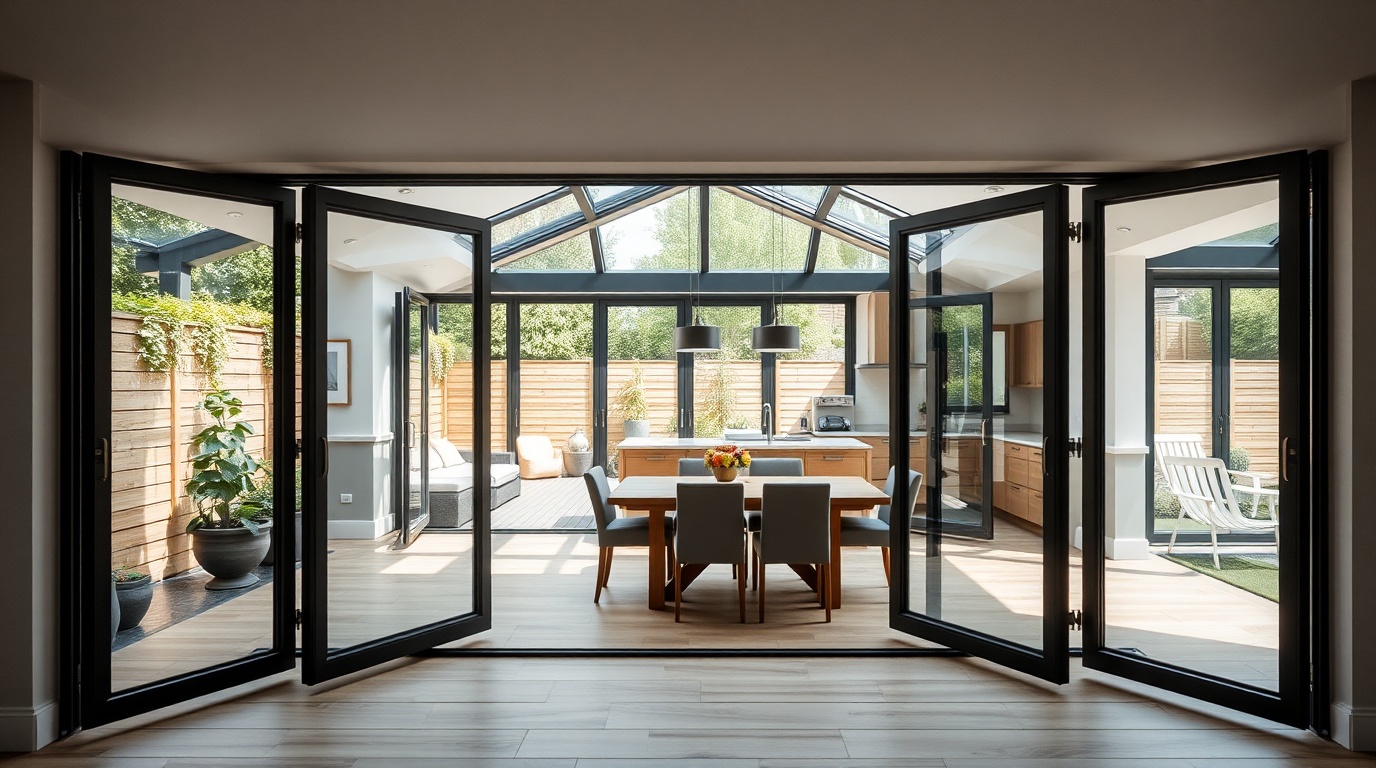
The short answer
An even bifold split divides the panels equally so they fold to both sides, while an uneven split sends more panels one way than the other, usually to allow a traffic door or to stack the panels clear of an obstruction. A four-pane door with a 2+2 split folds two panels each way from the centre. A five-pane with a 4+1 split folds four one way and leaves a single traffic door. The split you choose affects everyday access, where the folded panels rest and how the closed door looks. Even splits give symmetry; uneven splits give flexibility for access and awkward openings where one jamb is obstructed.
The split describes how many panels fold each way, which shapes both the look when closed and how the doors work when open.
Quick reference
- Even splitEqual panels each side
- Uneven splitMore panels one side
- Even example4-pane 2+2
- Uneven example5-pane 4+1
Common splits by panel count
The table shows typical even and uneven splits for common panel counts. The notation, such as 2+2 or 4+1, describes how many panels fold each way from the meeting point. Even numbers of panels can divide equally; odd numbers cannot, so they always use an uneven split, which conveniently suits a traffic door.
The available splits vary by system, but the principle is consistent: an even count opens up a symmetrical option, while any count can be set to fold mostly one way if that suits the room better. The surveyor confirms which splits the chosen system offers for your panel count.
| Panels | Even split | Uneven split |
|---|---|---|
| 3-pane | Not possible (odd) | 2+1 (traffic door) |
| 4-pane | 2+2 | 3+1 or 4+0 |
| 5-pane | Not equal (odd) | 4+1 or 3+2 |
| 6-pane | 3+3 | 5+1 or 4+2 |
Indicative for guidance; available splits vary by system.
When to choose each split
The right split depends on access, stacking and symmetry. Think about how you walk in and out, which jamb has clear space for the folded panels, and whether the closed door needs to look balanced across the opening.
- Even split: folds panels equally to both jambs, giving a symmetrical look and clear access from the centre. Good where you want the stack divided and no single traffic door.
- Uneven split: sends more panels one way, which suits a traffic door at one end or clears the panels away from a fixed obstruction like a wall return or radiator.
- Stacking space: an uneven split lets you keep the folded panels off a particular side, useful in tight rooms or against furniture.
- Traffic door: uneven splits with an odd leaf naturally accommodate a hinged access door for everyday use.
How the split affects use
The split changes how you live with the doors. An even 2+2 four-pane opens from the centre and stacks symmetrically, which looks balanced and works well where both jambs are clear. An uneven 4+1 five-pane keeps a single traffic door for daily use and stacks the rest to one side, which is convenient when you mostly want quick access and only fully open the doors occasionally.
Consider where furniture sits, which side has space for the folded stack, and whether you want a traffic door. The fold direction also affects the view from inside, since the stacked panels sit against one or both jambs when open. The surveyor can advise the right split once they see the opening and understand how the room is used, turning your preferences into a configuration that folds cleanly and suits the space.
Symmetry, sightlines and cost
From the outside and inside, an even split gives a balanced, symmetrical appearance with the meeting point in the centre of the opening, which many people prefer on a feature glazed wall. An uneven split places the meeting point off-centre, which is barely noticeable in use but worth picturing if the closed-door look matters to you. Neither split changes the slimness of the frames or the glazed area; that is governed by the material and panel count.
The split itself rarely changes the price, since the panel count, overall width and glazing are the real cost drivers. So the decision is practical rather than financial: choose the even split for symmetry and a clear central opening, or the uneven split for a traffic door, awkward openings, or to keep the folded panels clear of an obstruction. Because the door is made to measure, the split is chosen at the survey to give the right everyday result for your room.
A useful way to settle the split is to walk through a normal day with the doors in mind. In winter, when the doors stay closed most of the time, how often will you step in and out, and would a traffic door at one end save unfolding the whole stack each time? In summer, when you throw the doors fully open, which jamb has the clear space for the folded leaves, and is there furniture, a radiator or a wall return that the stack should avoid? Picturing those everyday moments usually points clearly to either an even split for symmetry and central access or an uneven split for a traffic door and tidy stacking. Because the fold pattern is built into the made-to-measure door and cannot easily be changed later, it is worth spending a little time on this at the survey, so the doors stack where you want and open the way you actually use the room from the first day.
Frequently asked questions
Can a 3-pane bifold have an even split?
No. Three is an odd number, so it cannot divide equally. A three-pane uses an uneven 2+1 split, which conveniently allows a traffic door on the single panel.
Is an even or uneven split more expensive?
The split itself does not usually change the price much. Cost is driven by the panel count, overall width and glazing rather than the fold direction.
Which split works well for a corner or obstruction?
An uneven split is often better near a corner, radiator or wall return, because it lets you stack the folded panels away from the obstruction rather than against it.
Does the split change where the doors meet when closed?
Yes. An even split puts the meeting point in the centre for a symmetrical look, while an uneven split places it off-centre. It is a visual difference that does not affect weather performance.
Can I change the fold direction later?
Not easily, because the split and hinge arrangement are built into the made-to-measure door. Decide the fold direction at the survey stage so the doors stack where you want from the start.
Sources & further reading
- HomeOwners Alliance — bifold doors guide
- Checkatrade — bifold door cost guide
- Which? — choosing external doors
Figures on this page are typical UK ranges drawn from published sources and depend on your specific opening and material. They are guidance, not a quotation.