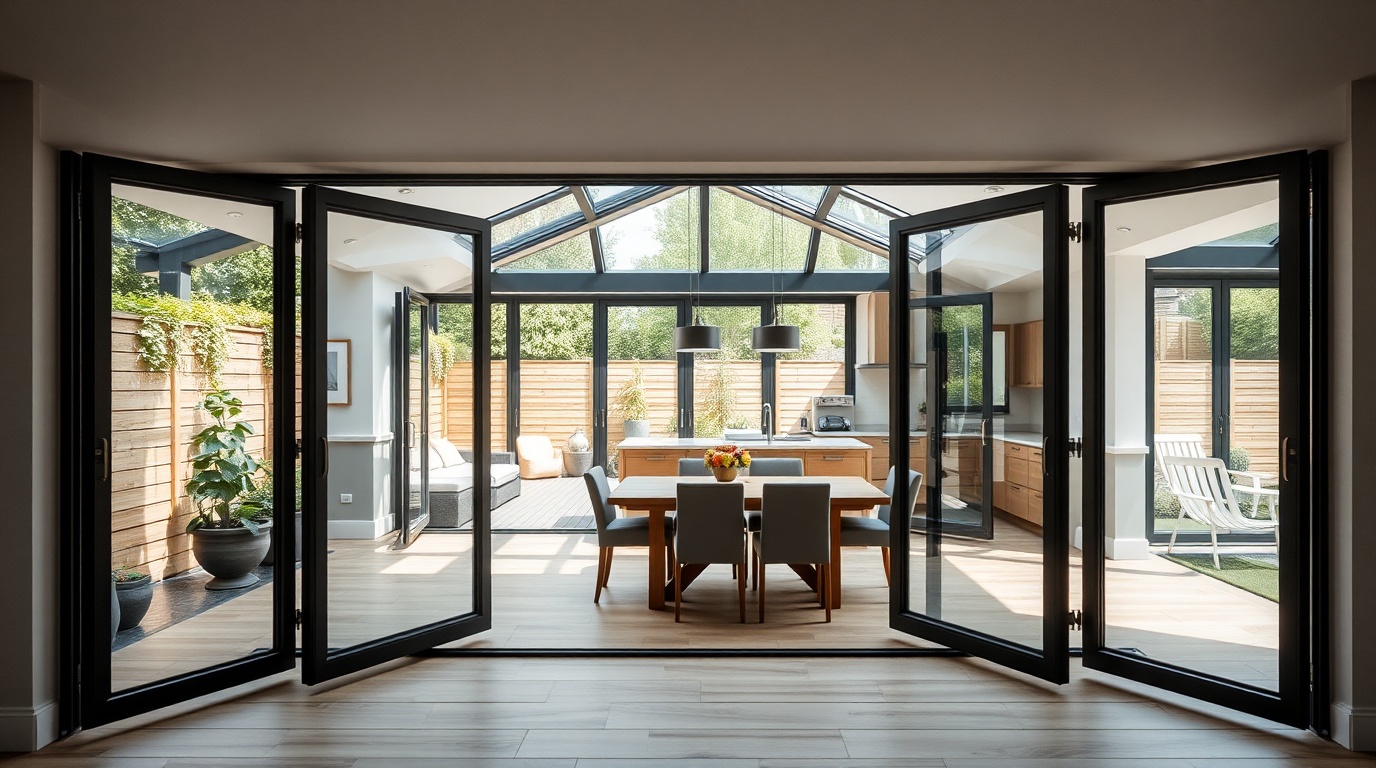
The short answer
Internal bifolds open the widest and stack tight against the wall, while internal sliding or pocket doors save the most floor space and give a cleaner look when closed. As a room divider — say between a kitchen and a dining or living space — an internal bifold folds its panels flat to one side, so you can open almost the whole gap and join the rooms completely. A sliding door slides one panel past another, or into a wall cavity (a pocket door), which uses no swing space at all but only ever opens part of the gap unless you build a pocket. Bifolds suit those who want to fully open up the rooms; sliding and pocket doors suit tight layouts where every bit of floor and wall matters. Both manage light and a degree of sound separation, with glazed options for either.
Internal dividers let you split rooms for warmth and quiet, then open them up when you want one big space. Bifolds and sliding (including pocket) doors do this differently. The sections below compare them on the factors that decide it indoors.
Internal divider at a glance
- Bifold openingUp to most of the gap
- Sliding openingPart of the gap (more if pocket)
- Floor spaceSliding/pocket saves most
- Closed lookSliding cleaner; bifold more frame
- SuitsBifold: full open; slider: tight rooms
How each works as a divider
Indoors, the priorities shift from a garden door. You usually care most about floor space, how much of the gap opens, and how clean it looks when closed. An internal bifold folds its panels flat against one side of the opening, so it opens most of the gap and joins the rooms almost completely — good where you want the two spaces to become one. The folded stack sits against the wall, taking a little space at the side.
An internal sliding door slides one panel past another along a track, so it needs no swing space, but a surface-mounted slider only ever opens part of the gap because one panel overlaps the other. A pocket door solves that by sliding into a cavity built inside the wall, disappearing entirely — the most space-efficient option of all, though it needs the wall built or adapted to take the pocket. The table sets out the trade-offs.
| Factor | Internal bifold | Sliding / pocket |
|---|---|---|
| How much of the gap opens | Most of it | Part (all, if pocket) |
| Floor/swing space needed | Small side stack | None |
| Look when closed | More frame (panels) | Cleaner, fewer uprights |
| Wall works | Minimal | Pocket needs wall cavity |
| Sound separation | Good (with seals) | Good (pocket can be weaker) |
| Typical cost | Mid | Slider low-mid; pocket higher |
Indicative guidance for internal dividers; cost depends on size, glazing and wall works.
Space, light, sound and cost
On space, sliding and especially pocket doors win — they use no swing room, so they suit tight layouts where a folded bifold stack or a swinging door would foul furniture. A bifold needs a small amount of wall to stack against but still opens far more of the gap than a surface slider.
On light, both can be fully glazed (with toughened safety glass) to keep a borrowed-light feel between rooms, or solid for more privacy. On sound, neither is as good as a solid wall, but both give useful separation when closed, particularly with proper seals and acoustic glazing; a pocket door can be slightly weaker acoustically because of the cavity it slides into. On cost, a basic internal slider is usually the lowest-cost, an internal bifold sits in the middle, and a pocket door can cost more once you account for the wall construction. The right choice comes down to the layout: choose a bifold where you want to open the rooms up as fully as possible, a surface slider for a simple space-saving divider, and a pocket door where a completely hidden, flush divider is worth the extra wall work.
Frequently asked questions
Are internal bifolds good as a room divider?
Yes — an internal bifold folds its panels flat to one side, so it opens most of the gap and joins two rooms almost completely, then closes to separate them for warmth and quiet. They need only a small amount of wall to stack against, which suits most layouts.
Do sliding room dividers save more space than bifolds?
Sliding and pocket doors use no swing space, so they save the most floor space in tight rooms. A surface slider only opens part of the gap, though, while a pocket door opens it fully by sliding into the wall. A bifold opens more of the gap than a surface slider but needs a small side stack.
Which is better for soundproofing between rooms?
Neither matches a solid wall, but both give useful separation when closed, especially with good seals and acoustic glazing. A bifold or surface slider with proper seals can perform well; a pocket door can be slightly weaker because of the cavity it slides into.
Sources & further reading
- HomeOwners Alliance — internal doors and room dividers advice
- Checkatrade — internal door fitting cost guide
Figures on this page are typical UK ranges drawn from published sources and depend on your specific opening and material. They are guidance, not a quotation.